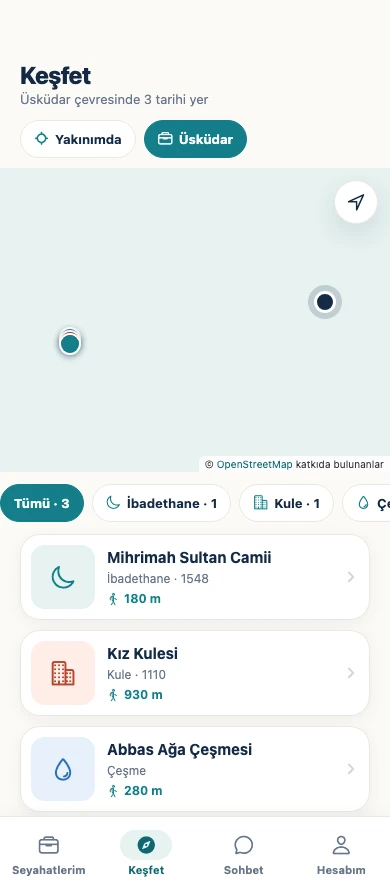
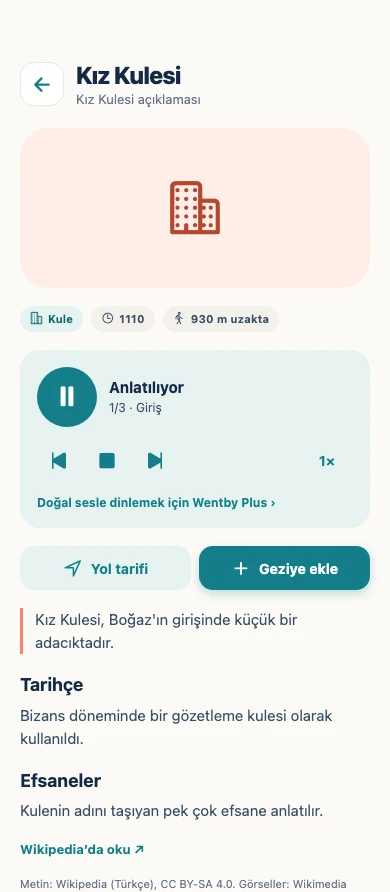
Discover shows the historic buildings around you on a map, tells you their past and adds the ones you like to your itinerary. It works whether you’re planning a trip or just wandering the city.
Three places, three cities
Turn a building, read its story.
From Rome to Istanbul to Ephesus: explore three of the places Discover tells you about in 3D. In the app every place follows the same layout: its type, year, distance and a story in chapters.
Drag to rotate · zoom
Ancient siteAD 70–80Rome, Italy
Colosseum
This vast amphitheatre in the heart of Rome was begun under Emperor Vespasian and opened under his son Titus in AD 80.
ListenDevice voice · natural voice with Plus
History
Built as the Flavian Amphitheatre, it hosted tens of thousands of spectators for gladiator fights and public spectacles. Crowds entered through numbered arches and could reach their seats within minutes.
What you see today
The southern side of the outer ring was lost to earthquakes and stone robbing, which is why the inner arcades are visible from outside. Beneath the arena, the hypogeum corridors where animals and scenery waited lie exposed.
Tower1348Istanbul, Türkiye
Galata Tower
Built by the Genoese as the highest point of the Galata walls, the tower has risen above the Golden Horn and the Bosphorus for centuries.
ListenDevice voice · natural voice with Plus
History
The Genoese called it the “Tower of Christ”. In Ottoman times it served as a watchtower and fire lookout, and its roof and upper floors were rebuilt several times.
What you see today
From its arcaded gallery you can see the historic peninsula, the Golden Horn and the Bosphorus at once. Its conical cap is one of the most familiar lines on Istanbul’s skyline.
Ancient sitec. AD 117Ephesus, İzmir
Library of Celsus
Built by Gaius Julius Aquila in memory of his father, Tiberius Julius Celsus Polemaeanus, the library is the most photographed façade in Ephesus.
ListenDevice voice · natural voice with Plus
History
The library held thousands of scrolls, and Celsus himself is buried beneath it. Niches in the façade hold four statues representing wisdom, virtue, thought and knowledge.
What you see today
The two-storey façade you see today was re-erected in the 1970s from pieces found among the ruins. The offset between the column pairs of the lower and upper storeys makes the façade look wider than it is.
In the app, every story comes from Wikipedia and images from Wikimedia Commons, with source and licence always shown. The models are illustrative drawings by Wentby.
How it works
A walking guide in three steps.
1
See what’s around
Use your location or pick a point on the map; historic places nearby appear on the map and in a list sorted by distance.
2
Listen to the story
Each story is split into chapters. Read it, or listen with your phone in your pocket — in your device’s voice for free, or in a natural voice with Wentby Plus.
3
Add it to your trip
Add a place you like to the trip’s itinerary in one tap, or open directions.
9:41
9:41
Narration
Two voices, one story.
Stories are read chapter by chapter; the chapter being read is highlighted, and you can skip back and forth.
Free
Device voice
Your phone’s built-in voice, in English and Turkish, at 1× or 1.25× speed.
Plus
Natural voice
Natural-sounding English and Turkish narration from neural voices. Chapters prepared once start instantly the next time.
What counts
Only places that are truly historic.
Discover reads each place’s type from Wikidata and shows only historic building classes. General buildings and bridges are included only if they predate 1900 or are protected; cities, schools, stations and restaurants are never included, however old.
Places of worship
Tombs
Fountains
Towers and lighthouses
Palaces and pavilions
Castles and walls
Museums
Ancient cities
Monuments
Historic buildings
Sources
Open knowledge, open attribution.
You always know where Discover’s information comes from. Go to the source in one tap and see who made each image and under which licence.
Stories from Wikipedia (CC BY-SA 4.0). Turkish sources are searched first; English ones fill gaps and are clearly marked.
A place’s type, year and protection status from Wikidata.
Images from Wikimedia Commons, each with its author and licence.
For nearby searches your location is rounded to roughly 100 metres and never tracked in the background.
Beta is open
Plan your next trip with Wentby.
Anyone can start on the web today and add it to the home screen like an app. Apply for the closed beta of the iPhone and Android apps and your invite will arrive by email.